
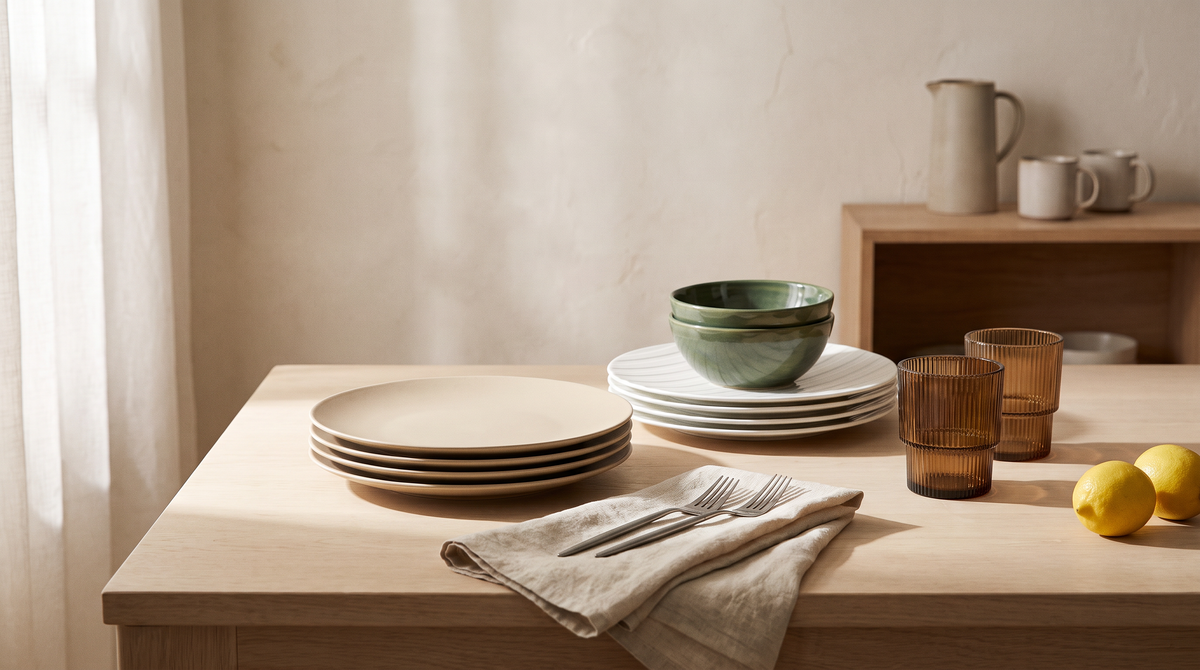
Boxed dinner sets solve the problem in one purchase and create two others. You get pieces you never use, and when one plate breaks the set stops matching. Buying piece by piece takes longer and ends better, particularly in a Spanish kitchen where cupboard space decides more than taste does.
How many you actually need
For a household of two, six to eight dinner plates is a comfortable everyday number. If cupboard space is tight and you run the dishwasher daily, one and a half plates per person is workable.
Own roughly as many small plates as dinner plates, since that is what makes setting the table simple. Bowls work the hardest of anything in the cupboard, covering cereal, soup, pasta and everything eaten standing up, so buy as many bowls as dinner plates or a few more.
The order to buy in
- Dinner plates. Four to start. The Flat Ceramic Dinner Plate is a wide matte beige plate at 37.70 euros.
- Bowls. The Ceramic Bowl Set Medina Green is 12.90 euros and does more work than any other piece here.
- Glasses. Glass Unico 300 ml in Chocolate at 4.90 euros each. Buy six, break two, still have four.
- Cutlery. Individual pieces rather than a canteen. The Dinner Fork Matte Stainless Steel is 8.90 euros.
- Small plates. The Stripe Relief White Ceramic Plate at 34.72 euros adds texture without adding a colour.
- Linen. Napkin Linen Beige, 14.90 euros for two.

How to mix without it looking accidental
Buy in simple, timeless shapes. A clean plate and a plain cutlery pattern will still look right in ten years, where a trend-driven set dates quickly. Then hold two rules:
- One colour family, two finishes. Matte beige and glossy white agree. Matte beige and cobalt do not.
- Let one piece be the handmade one. Hand-glazed stoneware varies from piece to piece, and that variation reads as intentional only when the rest of the table is plain.
This is the same logic as cutting a room's palette down, which we covered in five ways to make a rented flat feel more expensive.
What to skip in a small kitchen

If storage is limited, one neutral versatile set beats several themed ones. A ceramic plate that works for bread, dessert, tapas and a shared main is more useful than a plate that comes out twice a year. Skip the specialist shapes, the second colourway and the serving pieces until you have hosted enough to know which you would use.
Buy the plain pieces from the tableware range and the character pieces from the ceramic collection.
Hand-painted and handmade pieces vary slightly by nature, so no two are identical. That is the point of them.


